Pencho Gavira
La piel del tamborPencho Gavira is the Banco Cartujano’s ambitious vice-president and managing director, a self-made financier whose ascent is tied to a high-risk scheme linking a church demolition, a luxury development, and the troubled sale of Puerto Targa. Elegant and self-assured in public, he is privately exposed by concealed bank losses, political and ecclesiastical bargaining, and a marriage he treats as another problem to bring under control. His story traces the cost of turning people, institutions, and sacred ground into instruments of advancement.
Identity and Position
Gavira is introduced through the uneasy orbit of his subordinate, Celestino Peregil, who serves as his bodyguard and assistant. Peregil is on his way to a meeting in Triana, nursing a persistent ulcer and a gambling habit, while carrying a particularly compromising burden: he has sold journalists the information that enabled them to photograph Gavira’s wife, Macarena Bruner, with another man. The resulting magazine cover makes the personal scandal visible, but the exposure is also a reminder that Gavira’s own circle can become a source of danger.
Gavira’s appearance presents the opposite of Peregil’s nervous disarray. He is handsome, dark-haired, and meticulously dressed, with gold cuff links and a carefully arranged suit; his composure advertises money and success. The narrative describes him as ambitious and increasingly prosperous, while noting that much of what he has achieved is, in his own estimation, the result of effort. That conviction underwrites both his confidence and his sense of entitlement: he sees advancement as something he has earned and intends to consolidate.
His position at the Cartujano is powerful but not secure. He is the bank’s vice-president and director general, invested with nearly all the president’s authority, and is waiting to succeed the aging Octavio Machuca. Machuca’s sponsorship has helped make his rise possible, but the older banker retains the authority to test, provoke, and remind him that advancement has conditions. Gavira’s place at the top therefore depends not just on business results but on managing the bank’s board, his patron, and the public image that makes his authority acceptable.
The Puerto Targa Scheme and the Church
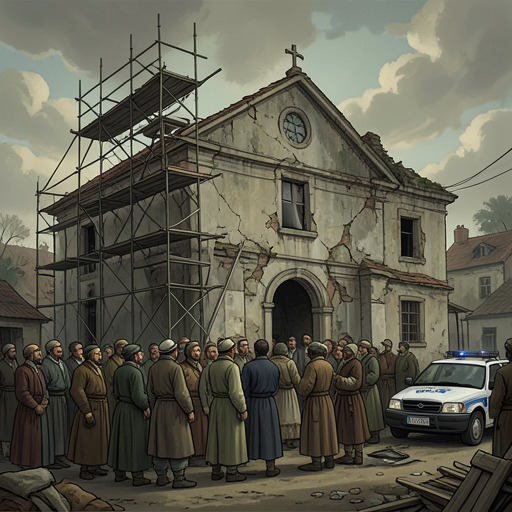
Gavira presents the redevelopment of Nuestra Señora de las Lágrimas as the key to a much larger transaction. The church occupies valuable land in Santa Cruz; his plan is to clear the site for development while bringing the Saudi-backed purchase of Puerto Targa to completion. He estimates that the combined urban opportunity and sale could reach between 180 and 200 million dollars. In his negotiations with Machuca, he argues for keeping the cost of securing cooperation as low as possible, while the older banker observes that the archbishop’s willingness to permit secularization, evict the parish priest, and see the church demolished has itself required careful political maneuvering.
The scheme carries a legal obstacle in addition to its moral and religious stakes. An old family privilege, documented in 1687, specifies conditions attached to the Bruner family’s land donation; if those conditions are not met, the land may revert to the Bruners. A later nineteenth-century law concerning church-property confiscation, however, provides for land to revert to the municipality in the event of secularization. A lawsuit by the duchess and her daughter could delay the project, putting Gavira’s investments and his standing with the Cartujano board at risk. The church is thus not merely a valuable site: it is the point where family claims, ecclesiastical consent, municipal authority, and Gavira’s financial future collide.
The internal investigation of the bank reveals why he is so dependent on the Puerto Targa sale. The project was presented as a route to a profitable sale to Sun Qafer Alley, a Saudi group, and as a means to regularize the bank’s rising risks. Yet Puerto Targa, originally capitalized at five million pesetas, was enlarged to nine billion after the bank acquired 78 percent of its shares at Gavira’s instigation; the remaining 22 percent stayed with private holders, including an offshore company suspected of links to him. The proposed luxury golf course, villas, and marina lay near the protected Doñana reserve, and the administrative obstacles to building there were unexpectedly lifted after the regional government had opposed the project.
Investigators found that the sale had not materialized while the bank’s exposure continued to grow. They identified 20.028 billion pesetas in risks, of which only 7.020 billion related to Puerto Targa. The company had, in effect, been financed almost entirely by the Cartujano through a complex chain of Gibraltar-based entities that concealed the bank’s role from much of its board. One purpose of the arrangement was to make the bank’s earlier accounts look profitable: the Cartujano appeared to earn 7.020 billion pesetas from the purchase, although it had effectively paid itself through the sale of Puerto Targa among its own shell companies. A future sale to Sun Qafer Alley was supposed to generate the gains needed to cover a hole of more than ten billion pesetas.
The report describes the bank’s accounts as systematically dressed up, its risks as dangerously high, and its search for new funds as frantic. It also identifies questionable payments to professionals and private individuals, including possible bribes, and Gavira’s involvement in client businesses and possible receipt of commissions, though the latter was not proved. Failure to complete the sale could bring severe consequences for the bank and public scandal among its conservative, often Catholic clientele—especially if the public learned how the financial maneuvering was connected to the proposed destruction of a church.
Gavira understands the urgency but continues to treat the plan as a necessary bridge to power. He regards Puerto Targa and similar transactions as ways to buy time while consolidating control of the Cartujano. The church redevelopment, conceived as an attraction that would help sell the wider scheme, is indispensable to that strategy: the proposed hotel in Santa Cruz is meant to make the area a luxury destination and to satisfy the interests behind the Saudi investment. His confidence is therefore built over an underlying deficit, with each new transaction intended to place another temporary step ahead of the one he has already used.
Boardroom Ambition and Political Bargaining
Machuca identifies the parish priest as a pivotal obstacle. Until the priest gives up, the mayor will not sell, the archbishop will not secularize the property, and Macarena and her mother will maintain their opposition. The Thursday Masses at the church frustrate Gavira’s plan by keeping the parish and its claims active. Machuca’s remark is also personal: he continues to call Macarena Gavira’s wife, refuses to accept their separation as settled, and warns that the marriage remains part of Gavira’s public and political standing.
Gavira responds by promising that he will recover Macarena once the church matter is resolved. Machuca makes explicit how deeply the marriage is entangled with his career: he appointed Gavira vice-president because Gavira married her. For the older banker, the union is not simply private affection but a credential connecting the ambitious outsider to an established Seville family. Without Macarena, Machuca suggests, Gavira risks looking like a wealthy upstart rather than a man securely admitted to the city’s old social order.
The impending debate over the church project is timed to the expected arrival of the Saudi buyers to purchase Puerto Targa. Gavira believes that once the agreement is signed, opposition within the bank will be silenced. At the same time, he is cultivating directors ahead of a board decision that will determine his future. He plans a lunch with three persuadable members and expects cooperation from a fourth, whose intimate vulnerabilities give Gavira leverage. He approaches the vote as a carefully staged contest, calculating both pressure and appearances; in his experience, winning over bank directors requires more style than bribing an ordinary clerk, even if the underlying transaction is no less transactional.
His political arrangements extend beyond the bank. Gavira offers the mayor, Manolo Almanzor, relief from a generous loan used to buy an expensive home in exchange for municipal rezoning of the church site, a preliminary sale agreement, and removal of obstacles to the Santa Cruz development. When Almanzor is visibly isolated at a social gathering on the eve of his political fall, Gavira gives him a whisky and stays beside him. The gesture is both humane-seeming and self-interested: Gavira still needs the mayor, has effectively bought his cooperation, and feels that this purchase carries a responsibility to his own pride. As he watches the discarded politician surrounded by social emptiness, he wonders whether anyone will offer him a drink when his own power fails.
Marriage, Scandal, and Public Image
Gavira’s marriage is already in public circulation before he can control what it means. The Q+S cover shows Macarena beside the bullfighter Curro Maestral, and Gavira initially experiences the image as an affront to his marital honor. But the threat he perceives is larger than jealousy. The church deal, his succession at the Cartujano, and the board’s willingness to back him are all at stake; a legal challenge by Macarena’s family could freeze the redevelopment just as his authority is being tested. His personal and financial crises reinforce one another, although he tries to treat both as matters that can be settled by leverage.
A conversation with journalist Honorato Bonafé reveals Gavira’s readiness to turn scandal into a purchasable service. Bonafé alludes to Macarena’s photogenic appeal, the bullfighter, and the priest from Rome; Gavira quickly weighs his options and asks what an image-management operation might cost. The exchange shows how he reacts to an approaching threat: not by confronting its truth, but by assessing its price and the amount of time he needs. He requires only a week’s reprieve, believing that after the key business moves are completed the scandal will matter less.
At formal gatherings, he sustains the appearance of control through dress, practiced courtesy, and social fluency. He moves through the room smiling, exchanging greetings and kisses, while whispers about Macarena follow him. He refuses to let them disrupt his expression and redirects his attention toward the archbishop and Machuca. Yet the painting beside them, Valdés Leal’s In Ictu Oculi, gives the scene an image of power’s fragility: Death extinguishes the candle before the insignia of rulers and clergy. Gavira calls the painting beautiful; the archbishop counters that its warning is nearer to older men, while Machuca remarks that Gavira is a triumphant man who does not fear his candle being put out. Their exchange casts his confidence against the possibility of abrupt reversal.
Character and Narrative Significance
Gavira’s characteristic method is to convert relationships and institutions into terms of exchange. The mayor’s loan can be canceled; the archbishop’s cooperation can be rewarded; the board can be pressured; a journalist can be paid for an image-management operation; and Macarena, in his promise to Machuca, can supposedly be recovered after the church deal is settled. This does not mean every exchange is equally controllable. The old land privilege, the parish’s continued life, the bank’s concealed liabilities, and Macarena’s separation all resist being reduced to Gavira’s timetable.
His social polish also exposes the boundary he is trying to cross. Machuca’s patronage and his marriage to Macarena have helped him approach the old Seville elite, but the banker’s warning makes clear that wealth alone does not guarantee belonging. Gavira’s title and money can secure invitations and influence; they cannot ensure that society will regard him as one of its own if Macarena withdraws her connection. His ascent remains dependent on the very relationship he treats as recoverable property.
The bank investigation sharpens the contradiction at the center of his self-image. Gavira sees himself as a man who has advanced through his own effort, but the transactions supporting his rise rely on concealed exposure, shell-company structures, uncertain future buyers, political favors, and possible conflicts of interest. The church land is made to carry the weight of the bank’s hole, while the bank’s potential collapse threatens to expose the entire arrangement. His ambition is not simply personal greed: it is a strategy to survive the consequences of earlier, inadequate management by creating a larger success before the losses become undeniable. The greater the promised rescue, the more precarious the present becomes.
Near the end of the supplied scenes, Gavira is still working the board and preparing for a decisive lunch, listening only distractedly as Machuca recounts an earlier shareholders’ meeting. He checks the time, rehearses the seating and sequence of persuasion in his mind, and then answers a call from his secretary in silence before thanking her and hanging up. The passage closes without disclosing what the call says or resolving his campaign. That pause preserves the uncertainty governing his trajectory: Gavira has plans for the bank, the church, and his marriage, but each depends on other people and institutions agreeing to remain within the bargain he has designed.